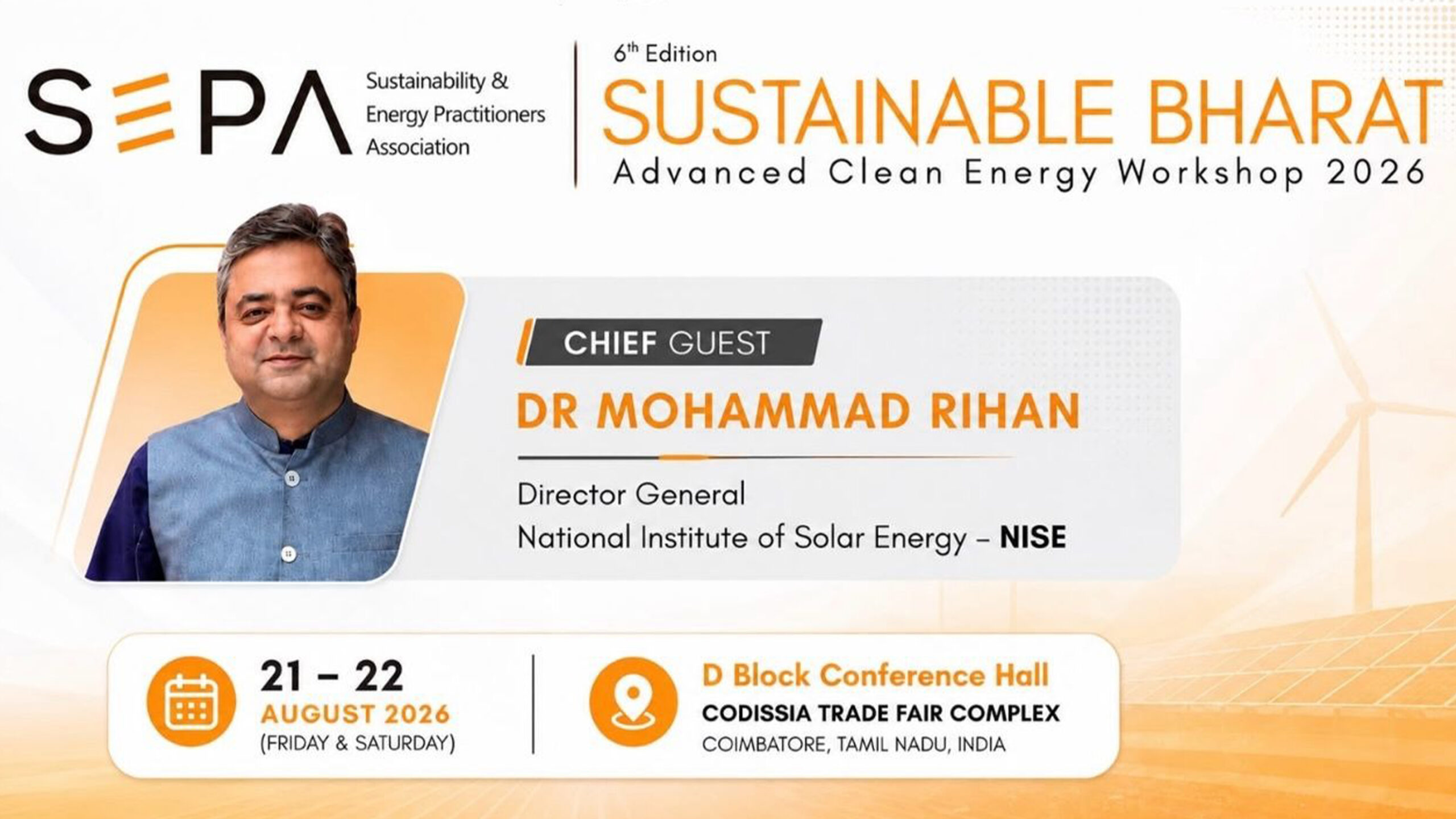

Sustainability and Energy Practitioners Association (SEPA) announced the 6th edition of Sustainable Bharat – Advanced Clean Energy Workshop 2026, scheduled to be held on August 21 and 22, 2026, at the CODISSIA Trade Fair Complex, Coimbatore.
Mohammad Rihan, Director General, National Institute of Solar Energy – NISE will be chief guest.
The workshop will bring together experts from industry, academia, research institutions, and the energy sector to discuss key technological developments and India’s changing clean energy landscape.
As India’s energy transition moves beyond renewable power generation towards comprehensive grid integration, the 6th edition will place a special emphasis on Battery Energy Storage Systems (BESS) for both utility-scale and Commercial & Industrial (C&I) applications.
Technical sessions and expert panel discussions will focus on Renewable Energy Integration and Grid Flexibility, System Reliability, Agrivoltaics, Carbon Capture, Utilisation and Storage (CCUS), and Environmental, Social and Governance (ESG) frameworks.
Dr. Raguram Arjunan, President, SEPA, said, “India’s energy transition is moving beyond renewable generation towards the effective integration of diverse energy resources. BESS will play an increasingly important role in enhancing system flexibility and reliability. Sustainable Bharat 2026 provides a timely forum to deliberate on these developments and shape practical pathways for India’s energy future.”
The workshop will feature distinguished leaders and experts, including Mohammad Rihan, Director General, National Institute of Solar Energy (NISE); Krishnan Komandur, Chief Executive Officer, Adar Poonawalla Clean City Initiative; and Ilja Pawel of RENAC AG, Germany.
The event will bring together prominent organisations from across the technology and clean energy ecosystem, including Yokogawa India Private Limited, Turno, Feston ESS, TrueRE–Oriana Power, and Atotech India Private Limited.
More about the workshop
Launch of the SEPA Students Council:
The 6th edition will also mark the official launch of the SEPA Students Council, which will focus on nurturing future-ready skills, research exposure, technical learning, and clean-tech innovation among young researchers and students.
SEPA Consortium Advancement:
SEPA provides an institutional framework for collaborative research and technology development between industry and academic institutions, supported by research funding from national research agencies.