

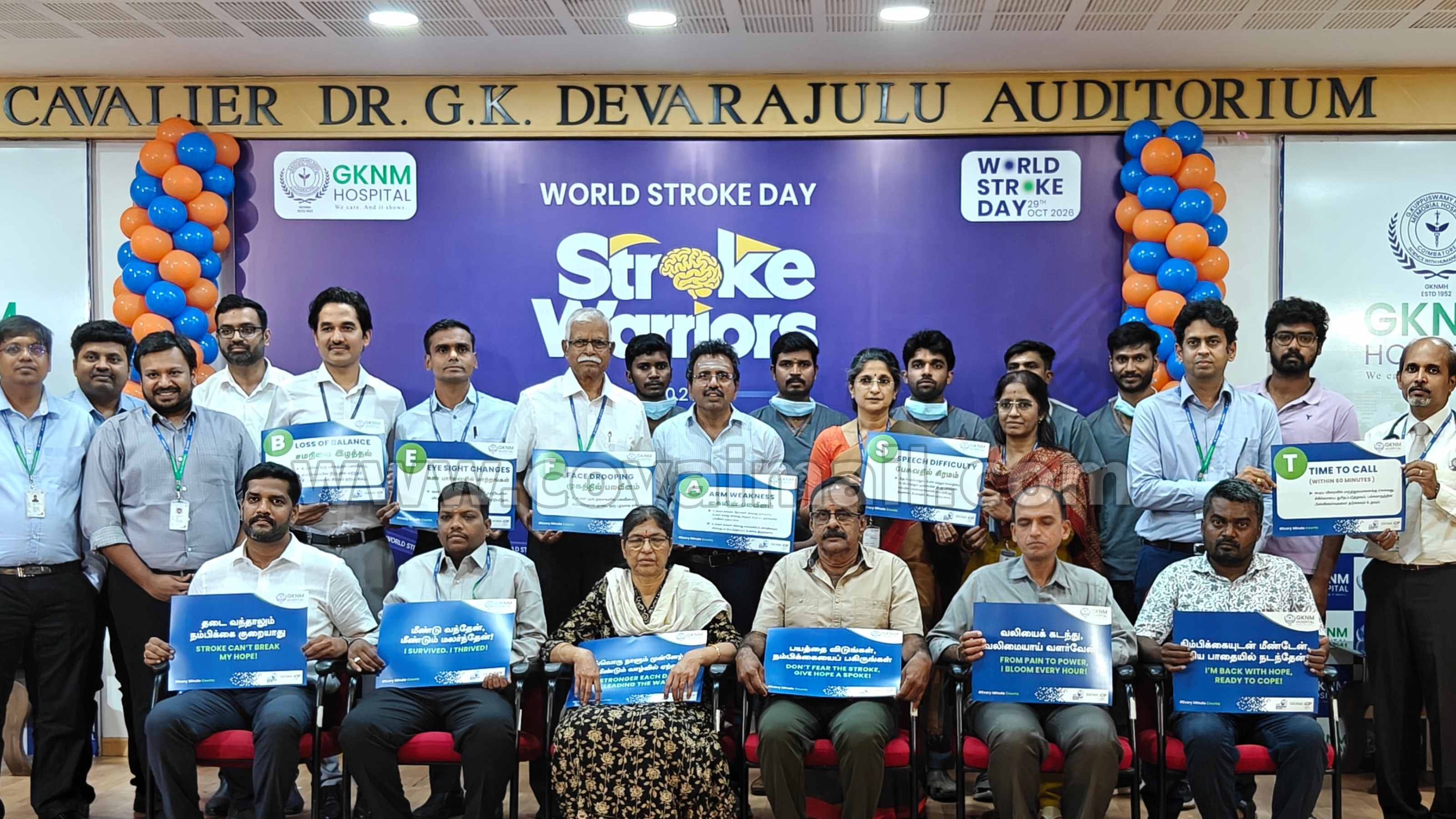
G.Kuppuswamy Naidu Memorial Hospital (GKNMH) observed World Stroke Day on Thursday at the hospital’s premises, and also honored persons who have successfully overcome stroke.
Dr.Manoharan, Chief Medical Officer, GKNMH presided over the event. Dr.Rasmiranjan Padhi, Chief Consultant Neuro Interventional Radiologist of the hospital welcomed the gathering. He appreciated the resilience of stroke-patients, who ventured into a journey aiming to achieve physical recovery and return to normalcy after undergoing treatment/surgery. “Today, we honor your journey and also honor the people who walked it beside you,” he said.
Dr.Rasmiranjan underlined that most of the outcome in stroke is decided before a patient reaches a hospital. He cautioned that if a person experiences loss of balance, visual problems, drooping of the face, weakness in the arm, difficulty to speak, immediate medical help should be sought.
Dr. Balasenthil Kumaran, Consultant Neurosurgeon of the hospital wanted the public to understand that stroke is not a disease of the brain but of the blood vessels. Even if just 5% to 10% of blood flows through the vessels, the person may still appear fine but once clot blocks the entire blood flow, stroke could occurs in minutes. Hence healthy lifestyle is important to prevent such scenarios.
He listed high blood pressure, diabetes, high cholesterol levels, smoking/alcohol consumption, and hereditary factors as the 5 main risk factors that cause stroke and also underlined that leading a stressful life and sleeping only 4 or 5 hours a night is also a critical factor. Poor sleep becomes an even greater risk factor than high blood pressure, diabetes, or cholesterol.
Dr.Ravichandran shared that gone are the days where stroke was seen as a disease of the elderly, affecting people aged 80, 90, or at minimum 60 to 70. He cautioned that strokes occuring among younger individuals have surged drastically.
Earlier, young patients suffering stroke accounted for around 5% of cases; but recent studies show that it has reached close to about 20%. It is feared to be even more. People generally take time to go for treatment if they have fever or other illnes but that is not an option with stroke. It is not about waiting for an hour or two; every minute counts, and you must seek help right away.
Dr. G. Manoharan expressed his belief that advanced stroke prediction is possible in this era of Artificial Intelligence. He appealed to the stroke care team of GKNM Hospital to explore the possibility of such study.