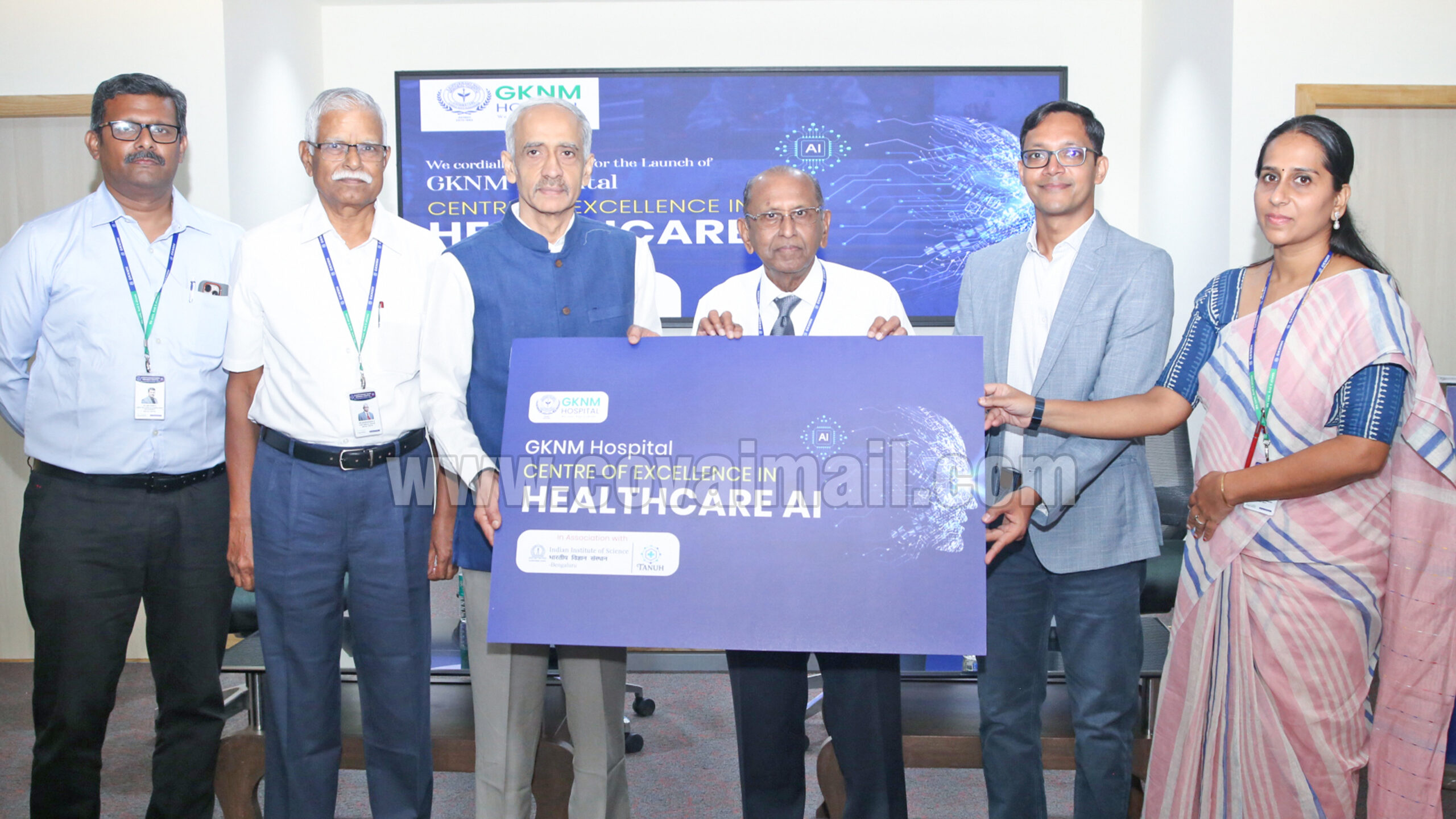

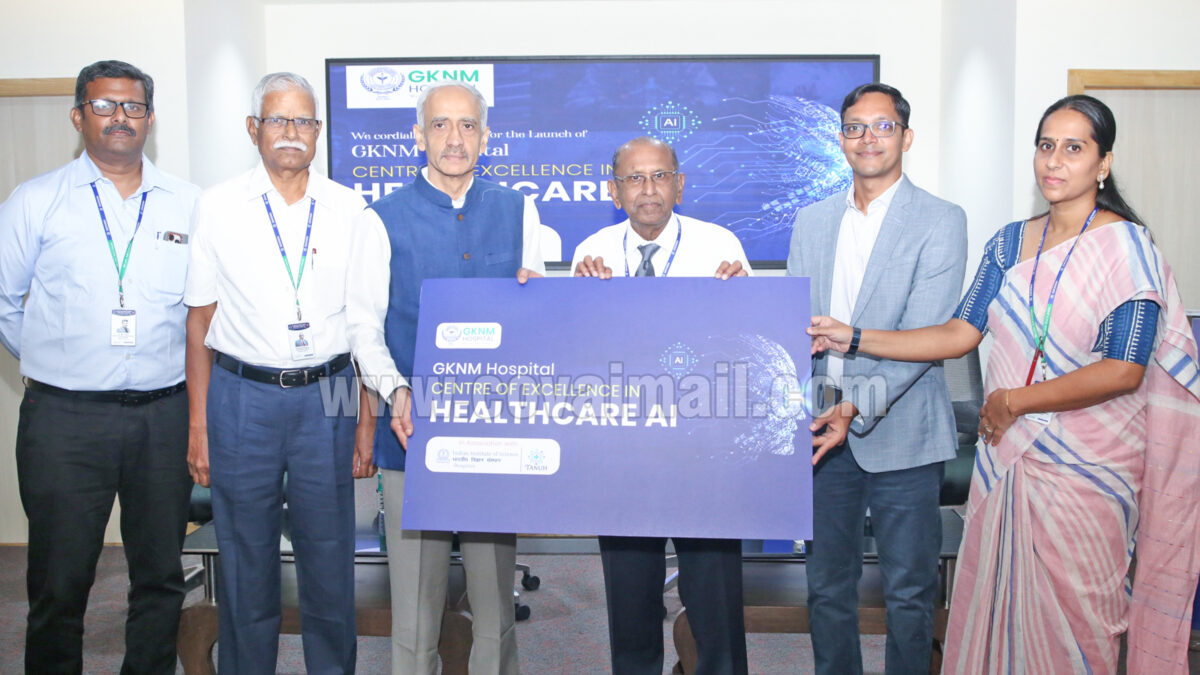
Kuppuswamy Naidu Memorial Hospital (GKNMH) recently launched the Centre of Excellence (CoE) in Healthcare AI in association with the Indian Institute of Science (IISc) Bengaluru and TANUH (Translational AI for Networked Universal Healthcare).
TANUH is a health artificial intelligence programme funded by the Ministry of Education, Government of India.
As part of this collaboration, six research projects involving IISc Bengaluru and TANUH will be undertaken through the CoE, with the aim of enabling earlier detection of breast cancer, diabetes, heart disease, and kidney disease among Indian patients.
The Centre was formally launched by the chief guest, Dr. Manoj Murhekar, Director, ICMR–National Institute of Epidemiology, Chennai, along with Dr. Ragupathy Veluswamy, Chief Executive Officer, GKNM Hospital.
They were accompanied by Rahul Singh, Chief Operating Officer, TANUH; Dr. Manoharan, Chief Medical Officer, GKNM Hospital; Dr. Mathan, Director of Research; and Pavithra Ramanath, Principal Research Scientist.
Learn to work intelligently with AI
-Dr. Ragupathy Veluswamy, CEO, GKNMH
The CEO, in his address, said, “We are living through a remarkable period in medicine. During our careers, we have witnessed tremendous advances in healthcare. Today, we are witnessing another major transformation—artificial intelligence (AI).”
“AI can make the greatest difference in healthcare. Think about our everyday clinical practice. We have vast amounts of medical data and years of previous records. No human being can process all this information simultaneously. AI can help us bring this information together, supporting better decision-making and making care more personalized.”
AI will not replace physicians; it will make them better, he stressed. A machine may recognize a pattern, but it does not truly know the patient sitting in front of us. It cannot replace compassion, human judgment, communication, or the trust between a patient and a healthcare professional. Technology can provide information, but the responsibility for care remains with us, he added.
“We must understand when to trust an AI system—and, equally importantly, when not to trust it. Do not fear AI, but do not blindly follow it. Learn to work intelligently with AI.”
“The future of healthcare will not be about doctors vs artificial intelligence. It will be about healthcare professionals who understand how to use AI wisely, working together with technology to provide better care.”
Improved outcomes
Chief Guest Dr. Manoj Murhekar
“This launch is a logical and natural step in GKNMH’s journey, and it comes at a very interesting time. AI in healthcare will improve the outcomes and make a significant difference by helping healthcare professionals diagnose diseases earlier. AI is a tool to assist doctors, not to replace them.
He further shared, “In India, diagnosis itself is not the problem, but diagnosing at scale is essential.” AI can play an important role in this area by supporting healthcare professionals in diagnosis, enabling better treatment and improved outcomes.”
In his address, he also expressed the willingness of the ICMR–National Institute of Epidemiology to collaborate with GKNMH.”
The 6 projects
- Breast cancer on mammograms. Software will assist radiologists in reading mammograms, with the aim of detecting cancers earlier and more consistently, and making screening practical for far more women than a limited number of specialists can personally read.
- Diabetes in pregnancy and after it. Diabetes that appears during pregnancy often returns years later as permanent diabetes. This project aims to identify, early in pregnancy, which women are heading that way — so that both mother and baby can be protected, and the mother can be followed up after delivery rather than lost to the system.
- An Indian brain model. Almost all the AI used in brain imaging today was built on Western patients. Along with IISc’s brain research centre, GKNM will contribute to building a foundation model on Indian brain data so that future research and care for stroke, dementia and other neurological conditions rests on people who look like our patients.
- A photograph of the eye to check the blood vessels. The retina is the one place in the body where blood vessels can be seen directly, without a needle or a scan. This project tests whether a simple retinal photograph can flag serious vascular disease early, sparing patients expensive and invasive tests.
- Catching kidney disease before it is too late. Kidney disease is usually silent until a great deal of function is already lost. This project combines a routine ultrasound with ordinary blood tests to see whether failing kidneys can be identified earlier than they are now.
- A kidney risk score that works for Indians. A widely used international score predicts who will progress to kidney failure and need dialysis. It was not built for Indian patients. This project checks how well it performs here and corrects it so that patients and families get honest, accurate warnings and time to prepare.