
“Expert knowledge on semiconductor design is a must for any nation aspiring to make it big in the field. Bridging this critical skill deficit is imperative if India is to carve out an enduring presence in the global deep-tech race,” said Suresh Kuppuswamy, CEO of Zepto Logic Technologies.
In a special interaction with The Covai Mail, the Harvard Business School alumnus who has played senior executive roles for global technology giants including TCS and IBM expressed his views about India’s ambitious plans and his own grand dreams in semiconductor sector.
US recently achieved a remarkable progress in this sector, with Apple Inc. reaching 2 nanometer semiconductor chips. This was not an achievement they made in a single day. It took them phenomenal investment, knowledge, infrastructure and outstanding R&D. Several years of hardwork and planning went into it.
He shared that establishing an end-to-end chip fabrication facility costs between $40 billion and $50 billion, and since the investment is phenomenally high, India at the moment cannot do it all at once and has divided the domain into fabless design and manufacturing, supported respectively by the Design Linked Incentive (DLI) and Production Linked Incentive (PLI) schemes.
Detailing India’s domestic needs across consumer electronics and the automotive sector, where a single vehicle relies on 200 to 300 chips; Suresh points out that these predominantly operate on chips that are greater than 20-nanometer nodes.
India’s own Tata Electronics is setting up a semiconductor plant in Gujarat’s Dholera and US-based Micron Technology is also establishing a Semiconductor plant at Gujarat’s Sanand. He was optimistic that India’s is gradually gearing up in semiconductor race and if India makes a strong global partnership, it may surprise everyone and achieve what world leaders did in the last 2 decades. It is possible for India to do that?
So what are the challenges ahead?
Highlighting global structural hurdles, Suresh pointed out that even Taiwan, which commands nearly 90% of global fabrication volume, remains entirely dependent on American and British Electronic Design Automation (EDA) tools like Synopsys, Cadence, and Siemens EDA.
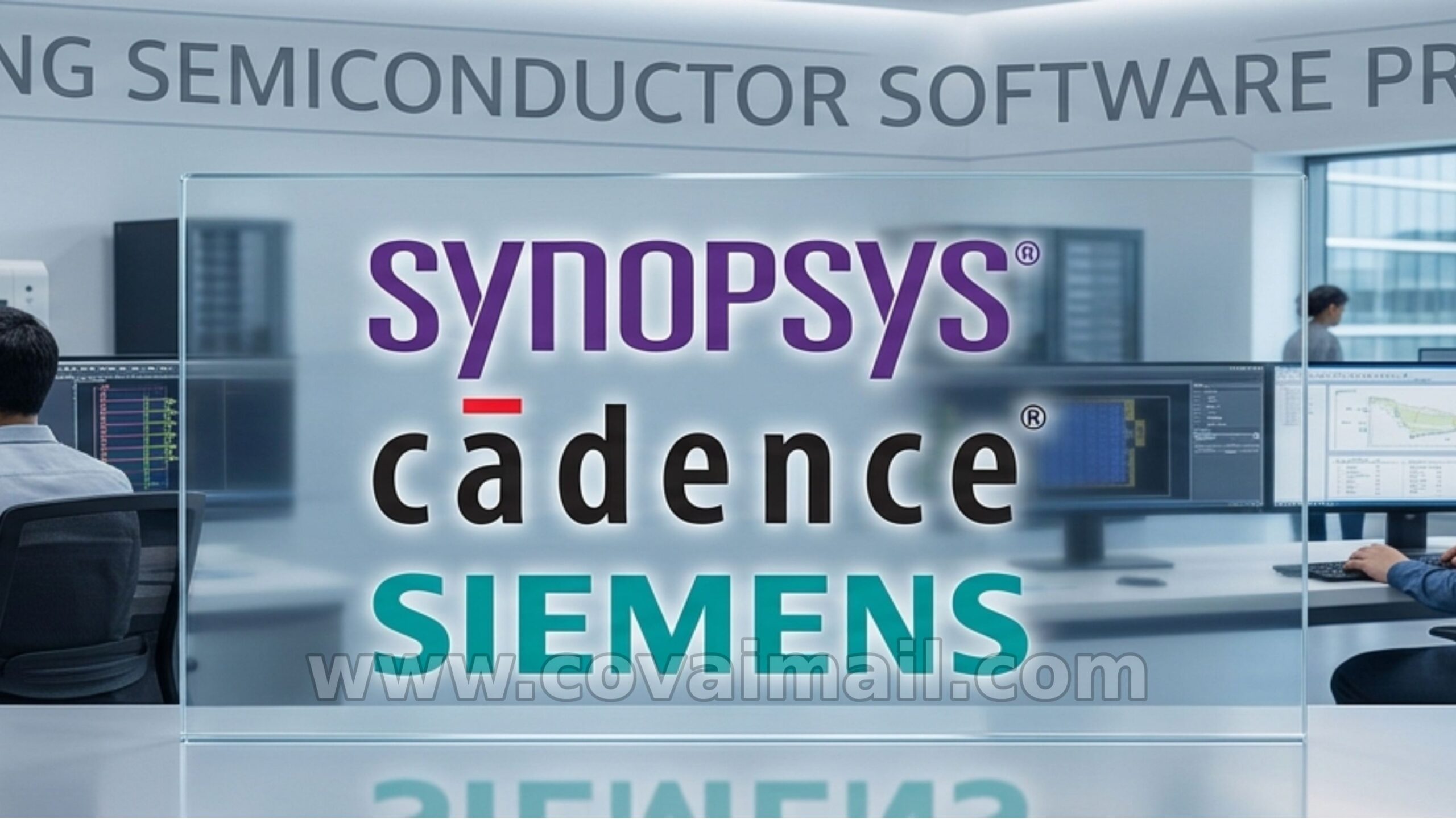
These tools command licensing fees ranging between $2 million and $3 million per seat. He underlined that semiconductor development requires synchronized partnership from myriad value-chain partners – from equipment makers like ASML and Applied Materials to complex chemical and gas suppliers like Entegris, SVCS Process Innovation, Applied Energy Systems.Reflecting on the unpredictable nature of R&D, he observes that the business environment has transitioned past VUCA (Volatile, Uncertain, Complex, Ambiguous) into a BANI world Brittle, Anxious, Non-linear, and Incomprehensible. In this setting, the technological gaps separating artificial intelligence, neural networks, semiconductor design, and quantum computing are rapidly closing.
China is pushing toward 5-nanometer thresholds without this software advantage, and will eventually develop its own EDA tools, and strengthen its position in the global semiconductor industry.
What India & Tamil Nadu should do?
India should work on this area and develop EDA tools. If it does, it is possible for India to register robust growth in Semiconductor sector. Talent, Partnerships, Govt-backing are crucial for private sector to make the nation’s aspiration come true.
Spearheading indigenous hardware research, Zepto Logic Technologies has emerged as the pioneer entrant to break ground at the newly developed 100-acre Semiconductor Industrial Park in Varapatti, Coimbatore by TIDCO.
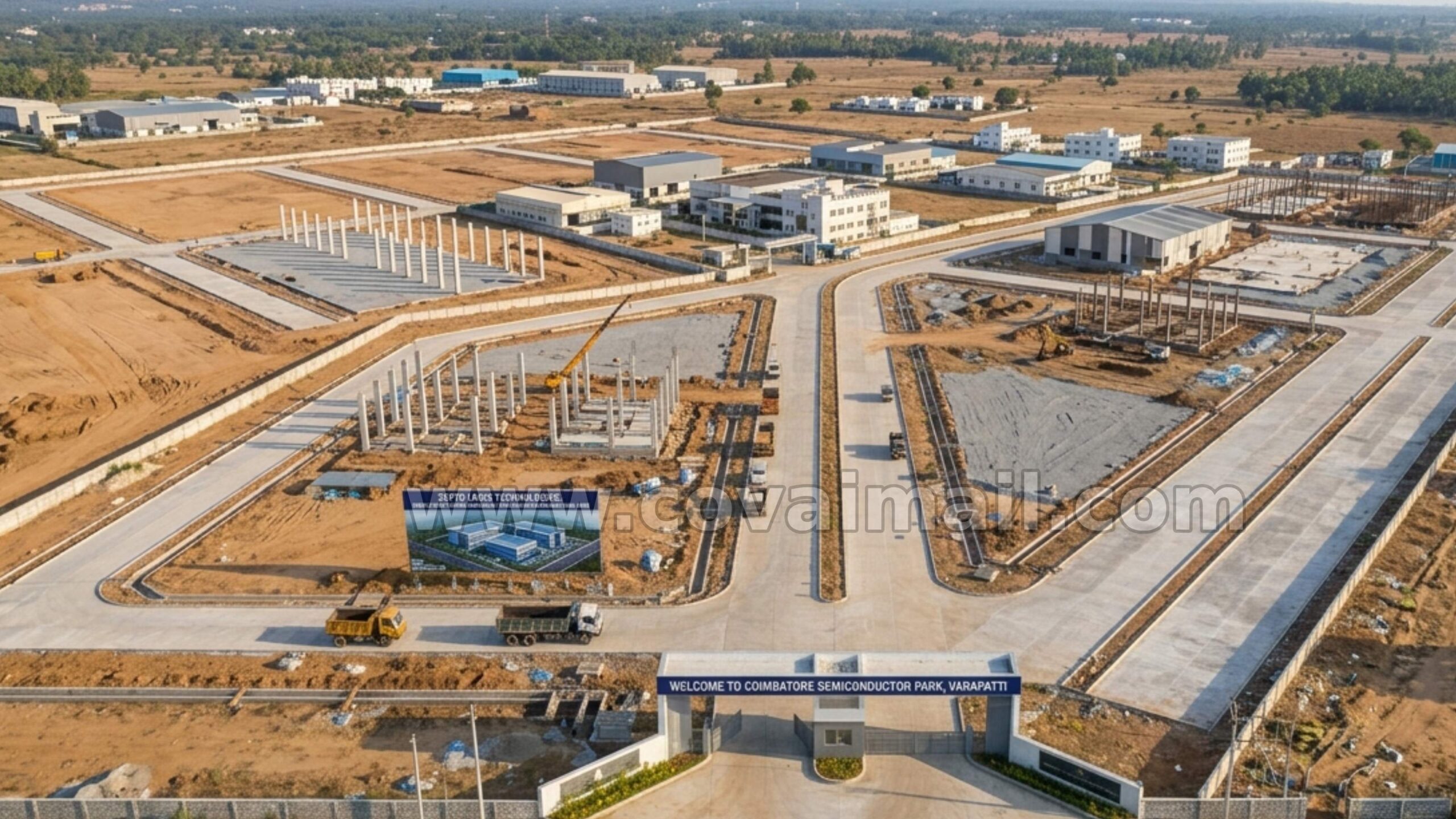 Zepto has been allotted 3.22 acres to erect its $50 million chip design campus and mini-OSAT/ATMP (Assembly, Testing, Marking, and Packaging) facility, dubbed Zepto APX. To bridge the local talent divide, the firm has partnered with institutions like PSG Tech and the Ramakrishna Group.
Having invested ₹2 crore of his personal savings into the venture, Suresh indicated that site construction at Varapatti is slated to commence over the coming year once state funding disbursements and administrative clearances are finalized. Should the backing by the Government of Tamil Nadu and central funds be robust, Zepto aims to make its upcoming campus at the Varapatti Defence Industrial Park, be a place where the foundational hardware architecture for India’s digital, cryptographic, and defense future are developed.
Addressing the status of other entrants at the Varapatti semiconductor park, Suresh indicates that funding delays remain the core obstacle preventing allotted companies from moving forward. He mentions that assembly and manufacturing players are considering the space.