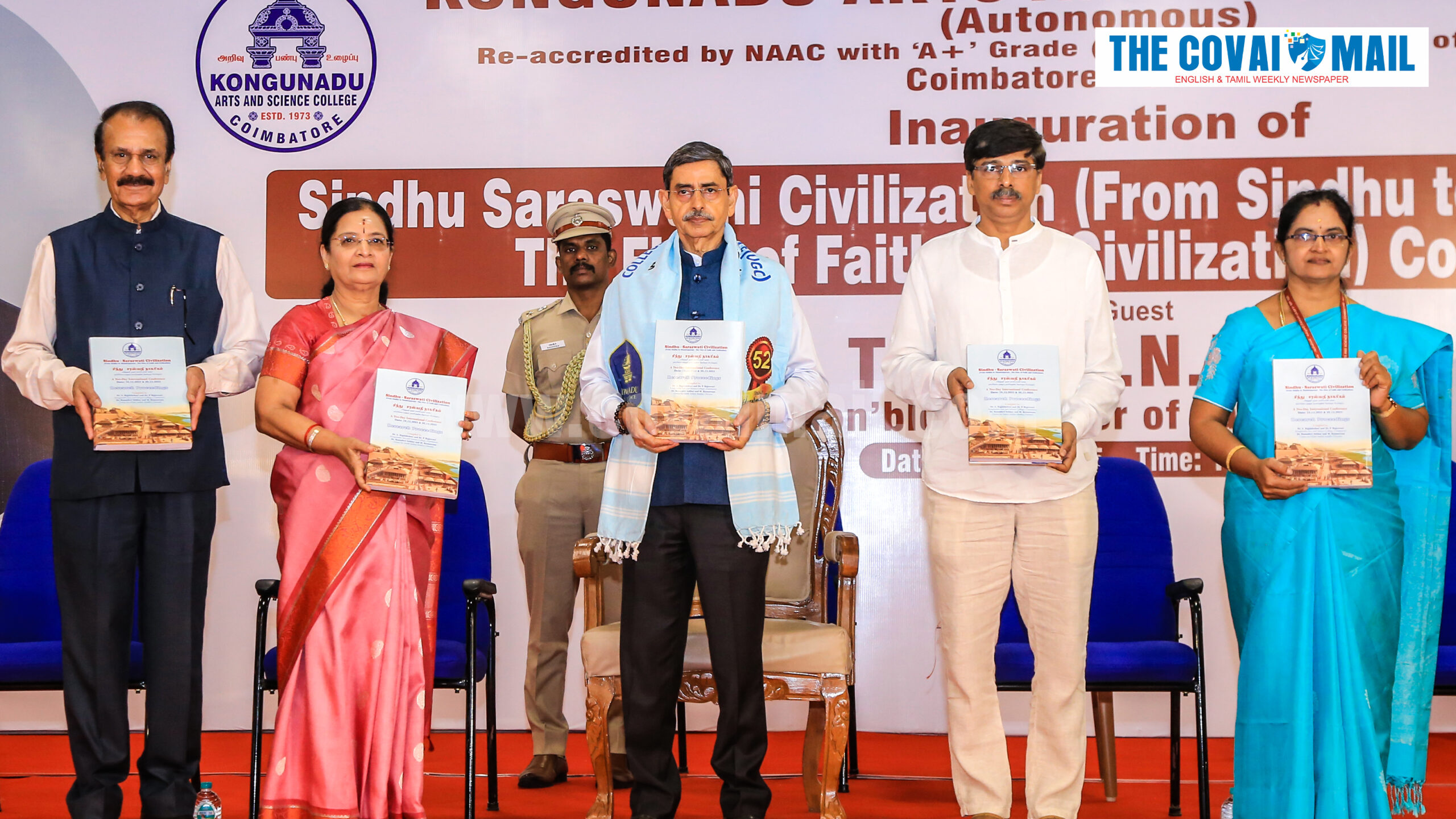


Kongunadu Arts and Science College, in collaboration with the Centre for South Indian Studies (CSIS), Chennai, recently organised a two-day conference titled “Sindhu Saraswathi Civilisation (From Sindhu to Thamiraparani – The Flow of Faith and Civilisation)” at the college premises.
The conference was inaugurated with the release of the conference souvenir by the chief guest, R. N. Ravi, Governor of Tamil Nadu. C. A. Vasuki, Secretary and Director of the college, delivered the welcome address and felicitated the chief guest by presenting a memento in the presence of Paramasivan, Treasurer of the college; Kumaresan, Convener; and Sandeep, Director of CSIS.
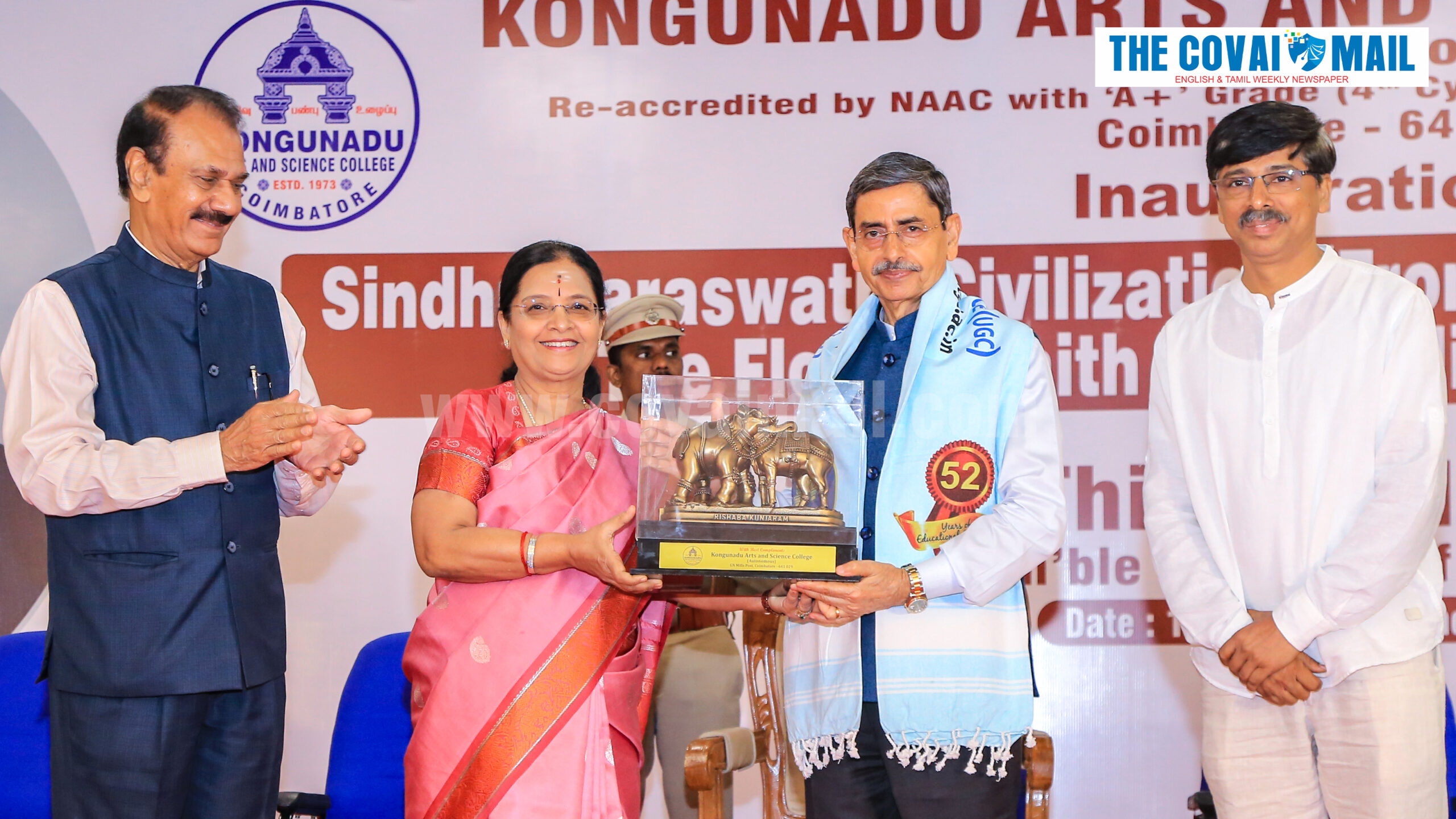
In her address, Vasuki highlighted the River Saraswathi and its tributaries, such as the Yamuna and Sutlej, and discussed the ecological and historical processes that led to its decline. She emphasised the importance of civilisational studies as a vital academic pursuit in contemporary scholarship.
Dharani Gunasekar delivered the introductory address, articulating the intellectual framework of the conference. He traced the flow of civilisation from the Sindhu–Saraswathi heartland to the southern river systems, with particular reference to Sangam-era ecological consciousness and cultural memory. He underscored that rivers are not merely physical entities but enduring carriers of ritual, faith, and collective identity.
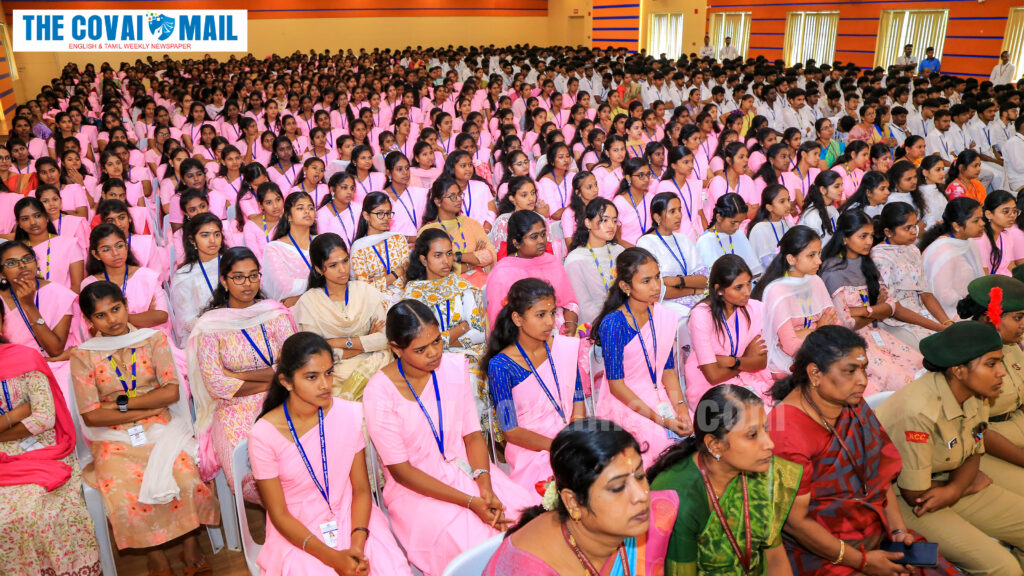
Governor emphasises rivers as the foundations of civilisation
In his address, Governor Ravi congratulated the college for organising a value-driven academic initiative and commended CSIS for its depth and rigour in researching India’s civilisational past. Situating Indian civilisation within a global comparative framework, he observed that the world’s great civilisations emerged along river systems, citing the Nile and the Tigris, before turning to the Saraswathi as a uniquely Indian civilisational axis.
He elaborated on the river’s flow, tectonic shifts, climatic changes, and eventual disappearance approximately 4,000–5,000 years ago, which led to demographic movements and cultural diffusion. Drawing upon Vedic literature, the Mahabharata, and classical Sanskrit texts, he established the historical, spiritual, and cultural presence of the Saraswathi.
He also cited Tamil literary works such as Agananooru, Thirukkural, and Manimekalai, illustrating how these texts depict human emotions and ethical values, demonstrating continuity across India’s literary traditions.
The Governor referred to the Mahabharata episode following the seventeenth day of the Kurukshetra war, when warriors are said to have bathed in the Saraswathi, and to narratives concerning King Parikshit, affirming textual and civilisational continuity.
Quoting Kalidasa, he reflected on rivers as dynamic geographical entities whose changing courses do not diminish their civilisational significance. His address weaved together verses from the Thirukkural, Purananooru, Silappathikaram, and the Rigveda, including the universal invocation “Bhadram Karnebhi…”, to highlight a worldview rooted in ethical universality, compassion, and interconnectedness.
He elaborated on the Sanatana philosophical vision, where multiplicity is understood as the manifestation of an underlying unity, noting that this idea forms the bedrock of Bharatiya civilisation. Linking ancient wisdom to contemporary discourse, he invoked the ideals of “Unnath Bharat,” “One Bharat,” and the G20 maxim “One World, One Earth,” suggesting that India’s civilisational ethos anticipates modern global humanism.
He also reflected on the destruction of ancient centres of learning such as Kashi during invasions, while highlighting South India’s role as a custodian of civilisational memory, often referred to as Dakshina Kashi. He cautioned against superficial scholarship and called for rigorous, evidence-based research grounded in intellectual honesty and cultural confidence.
The Vote of Thanks, proposed by Paramasivan, expressed gratitude to the Governor, scholars, dignitaries, organisers, faculty members, students, and volunteers.
About the conference
Over the two days, scholars participated in keynote lectures, technical sessions, and panel discussions addressing archaeology, literature, linguistics, religious traditions, and riverine cultures. Conceived as a serious academic engagement with India’s civilisational past, the conference sought to examine the continuities of culture, ecology, faith, and knowledge systems connecting the ancient Sindhu–Saraswathi civilisation with the riverine traditions of South India, particularly the Thamiraparani basin.
The conference brought together scholars from diverse disciplines—history, archaeology, literature, linguistics, philosophy, and religious studies—creating a fertile intellectual space to explore India’s civilisational unity beyond regional, linguistic, and temporal boundaries.