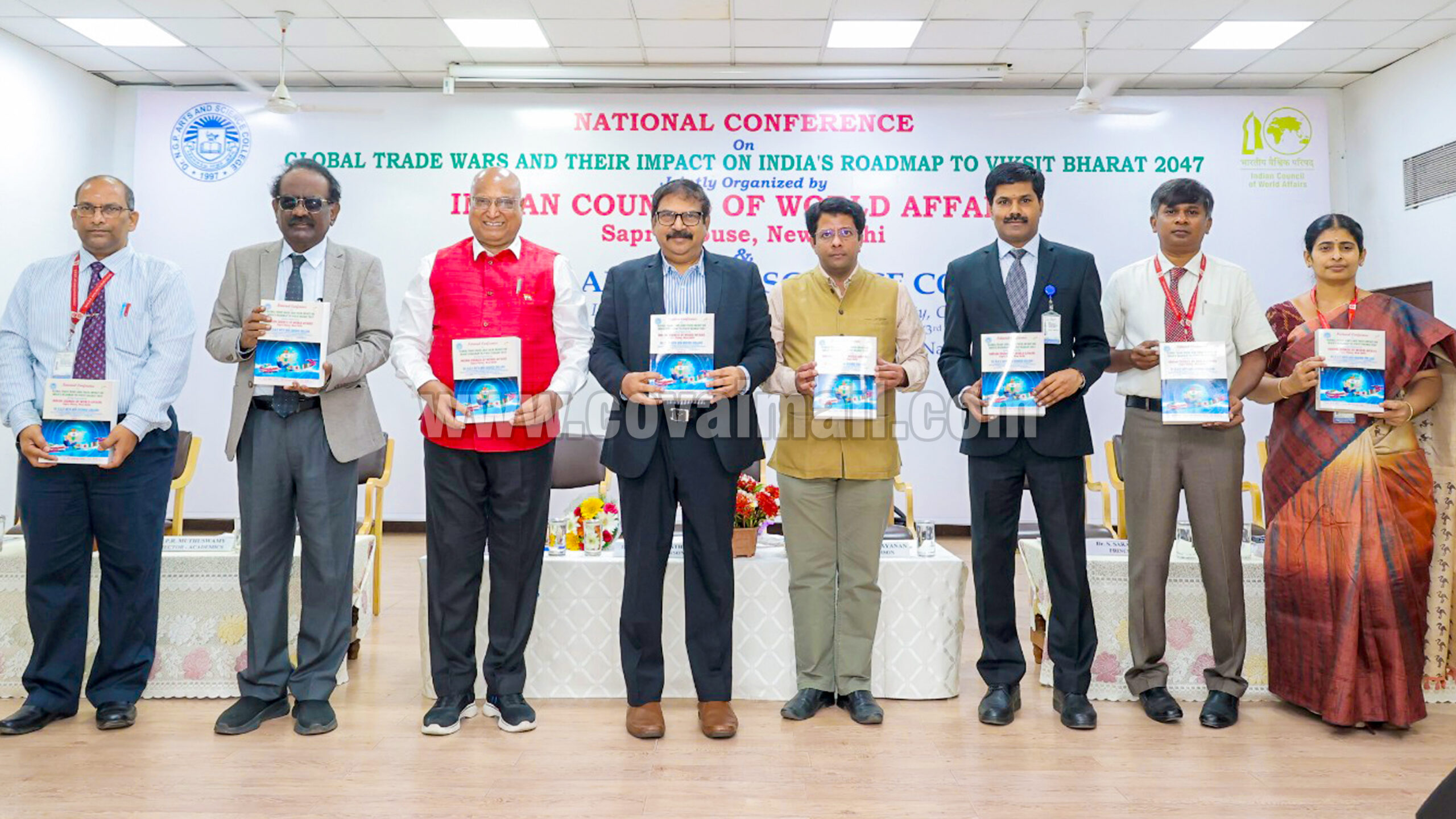

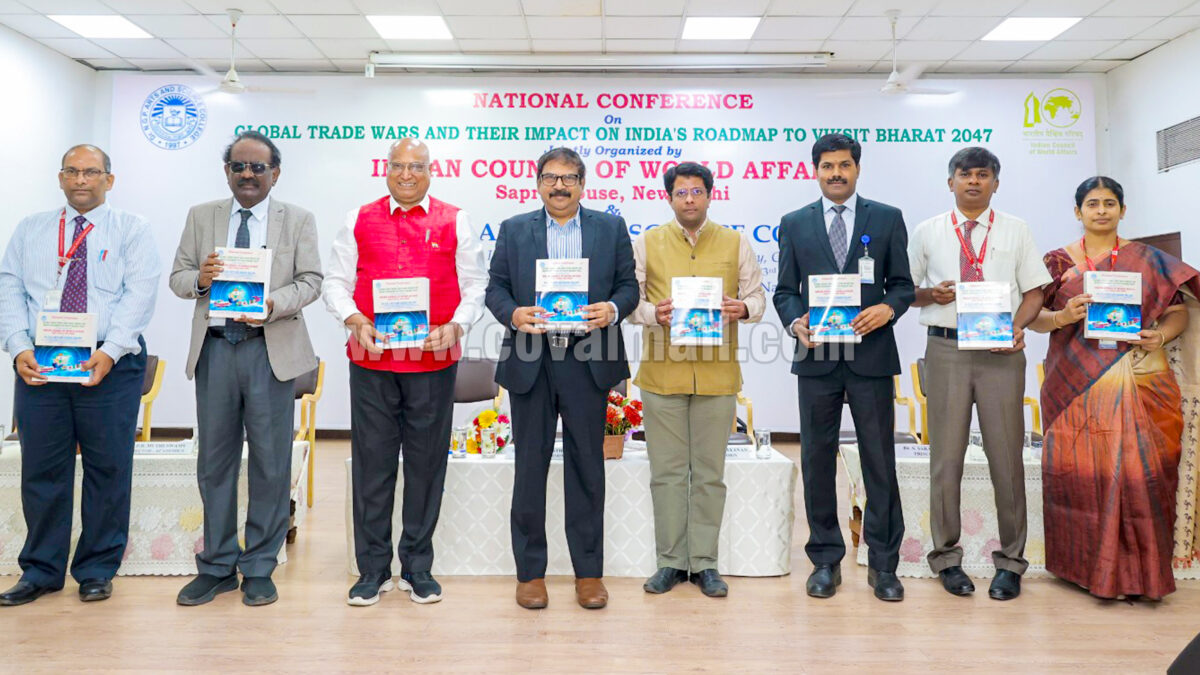
The Departments of Commerce with Professional Accounting and Management Studies of Dr. NGP Arts and Science College, along with the Indian Council of World Affairs, New Delhi, jointly organised a one-day National Conference today titled “Global Trade Wars and Their Impact on India’s Roadmap to Viksit Bharat 2047”
The conference witnessed the participation of nearly 300 delegates from various academic institutions and research organisations across the country.
The conference commenced with a formal inaugural session presided over by Saravanan, Principal of the college, who delivered the presidential address and emphasized India’s evolving role in the global economic order.
In his address, he highlighted the nation’s strategic positioning amidst shifting global trade dynamics and accentuated the importance of academic discourse in shaping policy perspectives.
The felicitation address was delivered by Sripathi Narayanan, Research Fellow at the Indian Council of World Affairs, he elaborated on India’s emergence as a significant alternative manufacturing and investment destination, attributing this growth to its demographic advantage, robust digital infrastructure, and expanding domestic market.
He further highlighted major governmental initiatives such as “Make in India,” “Atmanirbhar Bharat,” and the Production Linked Incentive (PLI) schemes as pivotal drivers of industrial growth and economic self-reliance.
Muthuswamy, Director of Dr. NGP Educational Institutions, delivered a thought-provoking address focusing on India’s strategic economic transformation.
He emphasised the need for diversification of trade partnerships, strengthening of domestic value chains, and fostering technology-driven innovation to mitigate external vulnerabilities and accelerate India’s trajectory towards becoming a $5 trillion economy.
The academic sessions were inaugurated by Panchanatham, Vice Chancellor of Gandhigram Rural Institute, Tamil Nadu. In his address, he offered a nuanced analysis of the increasing complexities of global trade tensions, particularly referencing the prolonged trade disputes between the United States and China, and their implications for emerging economies like India.
The subsequent sessions featured distinguished academicians and experts who provided diverse perspectives on global trade and India’s policy responses.
Madan Mohan Goel, Superannuated Professor from Kurukshetra University, Haryana, stated that India stands at a decisive trade juncture. As the world’s fourth- largest economy in 2026, with a GDP of approximately $4.3–4.5 trillion and sustained growth of 6–7 per cent, India’s global economic weight is rising steadily.
Exports in January 2026 crossed $80 billion, with services exports reaching record highs, reflecting India’s growing strength in digital, knowledge, and innovation-driven sectors.
Reetesh Kumar Singh, Professor in the Department of Commerce at University of Delhi, highlighted India’s evolving trade policy framework, noting its emphasis on negotiating from a position of strength.
He underscored India’s efforts to expand market access across more than 38 major economies, alongside ongoing negotiations for free trade agreements with the Gulf Cooperation Council and Israel.
These initiatives, he observed, reflect a strategic blend of economic diplomacy and innovation-driven engagement.
Further enriching the session, Ramesh Salian, Professor of Economics at the Centre for Economic Studies and Planning, Jawaharlal Nehru University, New Delhi, addressed the theme of sustainability, inclusion, and resilience in India’s trade roadmap.
He emphasised the importance of developing a sustainable export strategy, diversifying markets, strengthening supply chains, and aligning with global environmental and labour standards in the face of ongoing global uncertainties.