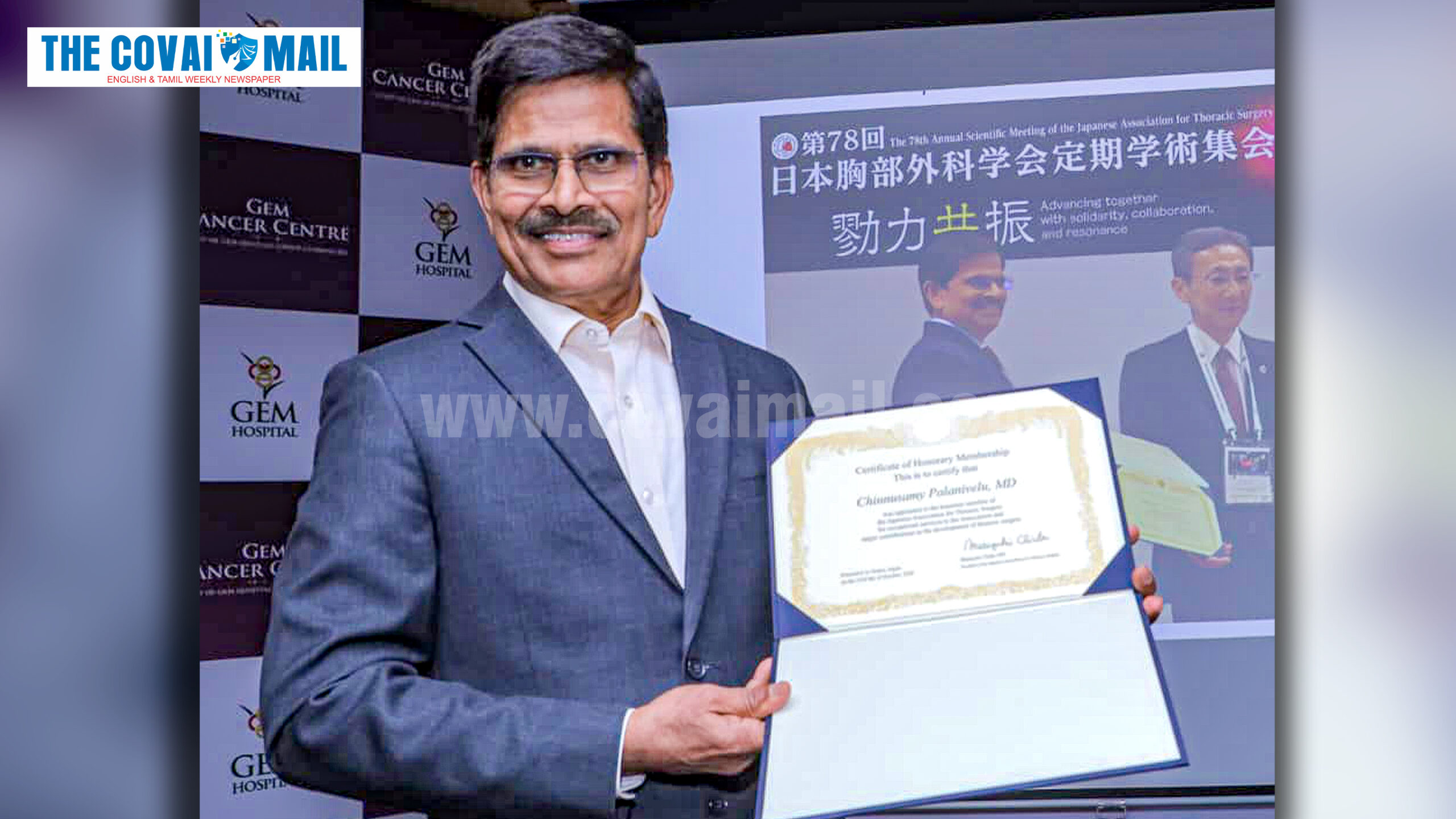

Dr. Palanivelu, Chairman of GEM Hospital and Research Centre, recently received an Honorary Foreign Membership conferred by the Japanese Association for Thoracic Surgery (JATS).
In connection with this, a press meeting was held today, 8th November 2025, at GEM Hospital, where Dr. Palanivelu addressed the media regarding the honour bestowed upon him.
Dr. Palanivelu was honoured for his groundbreaking contribution to minimally invasive esophageal surgery, which has had a profound impact on thoracic surgical practices in Japan and around the world.
His landmark 2006 publication in the Journal of the American College of Surgeons, titled “Minimally Invasive Esophagectomy: Thoracoscopic Mobilization of the Esophagus and Mediastinal Lymphadenectomy in the Prone Position – Experience of 130 Patients,” introduced a pioneering surgical technique that has since become the gold standard in Japan.
The innovative “prone position” approach developed by Dr. Palanivelu demonstrated remarkable outcomes, including a perioperative mortality rate of just 1.54%, a median hospital stay of eight days, and significantly reduced respiratory complications.
Dr. Palanivelu also delivered a special lecture on minimally invasive esophagectomy for cancer at the JATS 2025 meeting, where he was formally conferred with the honorary membership alongside other distinguished international surgeons. His presentation highlighted the evolution and global adoption of the prone position technique that has revolutionized esophageal surgery.
During the award ceremony, Masayuki Chida, President of the Japanese Association for Thoracic Surgery, remarked, “Palanivelu was the first in the world to devise thoracoscopic esophagectomy in the prone position. It is not an exaggeration to say that you changed the standard thoracic procedure for esophagectomy in Japan from the left-lateral decubitus position to the prone position. Your achievements and contributions to esophageal surgery in Japan are immeasurable.”
JATS Honorary Membership
The Japanese Association for Thoracic Surgery selects overseas doctors annually who have made significant contributions to the progress of Japanese thoracic surgery. This honor recognizes individuals whose work has fundamentally advanced the field and influenced surgical practice throughout Japan.
Dr. Palanivelu delivered a special lecture on minimally invasive esophagectomy for cancer at the JATS 2025 meeting, where he was formally conferred with the honorary membership alongside other distinguished international surgeons. His presentation showcased the evolution and global adoption of the prone position technique that has revolutionized esophageal surgery.
ABOUT ESOPHAGEAL CANCER
Esophageal cancer is the fourth most common cancer, and its incidence is increasing alarmingly due to lifestyle changes, obesity, and gastroesophageal reflux disease (GERD). Conventional surgery has been associated with high morbidity rates of over 40%, mortality rates exceeding 10%, and a cure rate of less than 15%.
Minimally Invasive Esophagectomy (MIE) has significantly reduced mortality and morbidity rates, enabling faster recovery and early resumption of normal activities. Early-stage esophageal cancer has now become completely curable, achieving cure rates of more than 90% in stages one and two.
In the conventional lateral approach, single-lung anaesthesia is used, which often leads to lung trauma and higher postoperative infection rates. Due to limited exposure, cancer clearance may be incomplete, resulting in poor long-term survival.
Dr. Palanivelu’s Prone Esophagectomy technique introduced a major breakthrough. The approach uses double-lung anaesthesia with wide mediastinal exposure and no lung handling, allowing complete cancer clearance. Patients recover from anaesthesia immediately after surgery. In his keynote lecture, Dr. Palanivelu also introduced a new anastomotic technique that eliminates the risk of leakage. His technique now achieves zero anastomotic leaks and zero mortality.
The prone position technique, now widely adopted globally, offers superior operative field exposure and improved ergonomics for surgeons while maintaining low respiratory complication rates. Multiple studies have validated the technique’s effectiveness, showing that it provides outcomes comparable to or better than traditional approaches.