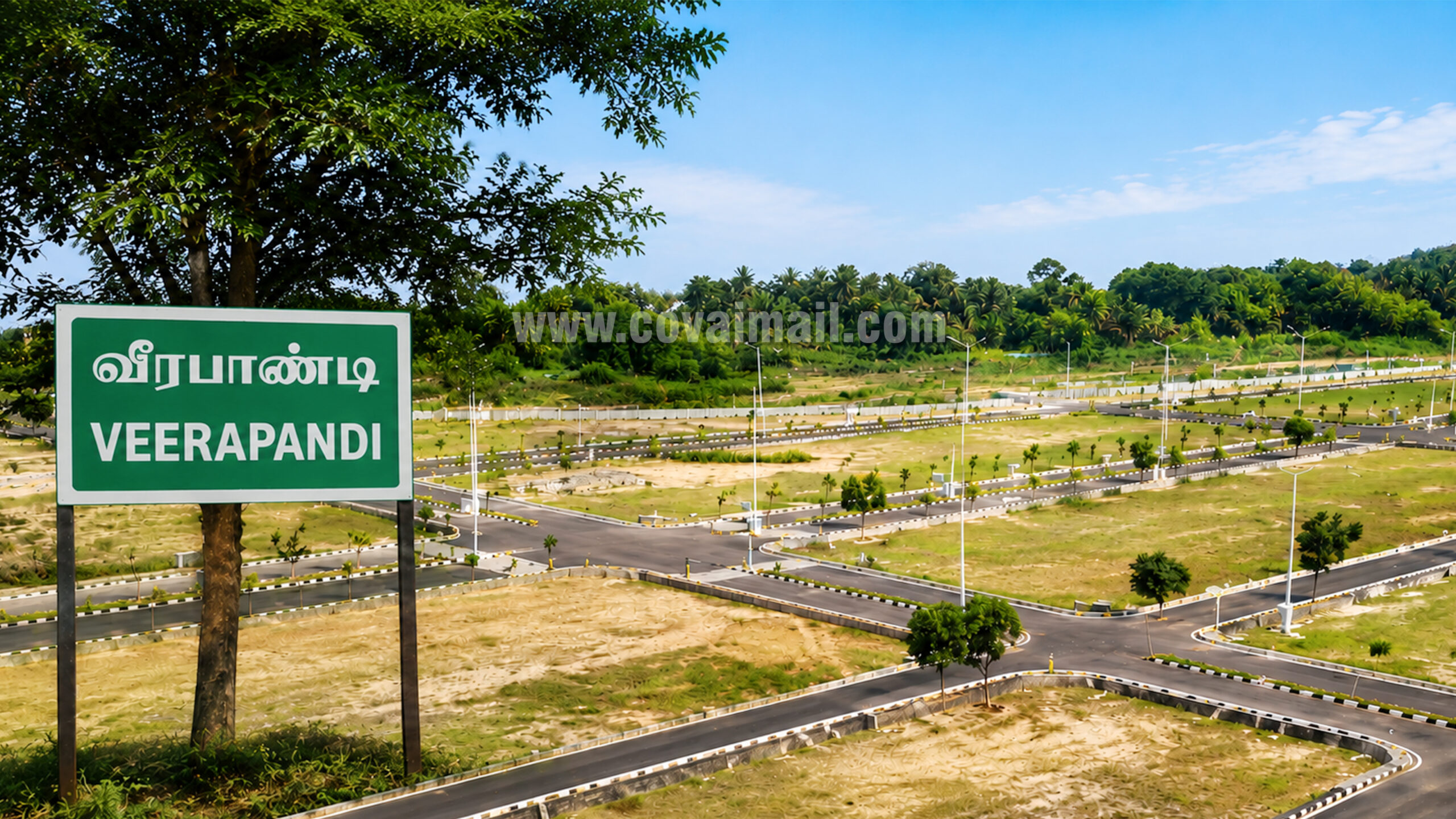

Coimbatore’s expansion over the past decade has gradually moved beyond its traditional city limits, with several suburban locations emerging as important residential and economic centres.
Driven by the growth of the IT, manufacturing and education sectors, areas along key corridors such as Mettupalayam Road and Avinashi Road have witnessed increasing development activity.
Among these emerging locations, Veerapandi has gained attention as a growing residential destination, supported by its connectivity, social infrastructure and proximity to employment hubs.
The steady development of these supporting ecosystems has also contributed to increasing interest in residential opportunities across emerging Coimbatore locations.
Located along the NH-181 corridor, Veerapandi has evolved from a suburban locality into an area with growing residential relevance. Its location provides access to established neighbourhoods, industrial areas, educational institutions and upcoming infrastructure developments, making it an important part of Coimbatore’s northward growth.
Connectivity has been a key factor in Veerapandi’s growth. The locality benefits from its proximity to the Coimbatore–Ooty Highway and established road networks connecting it with important parts of the city.
Infrastructure projects around northern Coimbatore are expected to further improve movement across the region. The proposed Eastern Ring Road, which connects important arterial routes including Avinashi Road to Sathyamangalam Road, is expected to improve connectivity and reduce travel time across the city.
Other infrastructure improvements, including the widening of the L&T Bypass Road and upgrades to major road corridors, are expected to strengthen accessibility for residents and businesses in the surrounding areas.
The ongoing development of the Periyanaickenpalayam Junction flyover is also expected to ease traffic movement along NH-181, reducing congestion for commuters travelling to and from the Ooty–Mettupalayam Road corridor while improving connectivity towards northern Coimbatore.
Improved accessibility has historically played a key role in shaping residential growth, with better-connected suburban locations often witnessing increased demand and gradual appreciation as infrastructure matures.
The region is also set to benefit from several road infrastructure initiatives aimed at improving regional connectivity and easing movement across key growth corridors. The strengthening and widening of NH-81 (Coimbatore–Karur Road) is expected to enhance connectivity between Coimbatore and surrounding economic zones, supporting smoother travel and improved accessibility.
Additionally, the evaluation and revitalisation of more than seven proposed scheme highways, ranging between 30–80 feet wide, will further strengthen connectivity between major arterial roads including Avinashi Road and Mettupalayam Road. These infrastructure upgrades are expected to improve mobility across emerging residential and commercial corridors while supporting future development activity.
The ongoing expansion of the L&T (Larsen & Toubro) Bypass connecting Avinashi Road to Sulur via Neelambur, which is planned for widening from two lanes to four lanes, is another significant connectivity enhancement expected to improve travel efficiency across eastern Coimbatore.
Furthermore, the development of five new scheme roads by Coimbatore City Municipal Corporation (CCMC) is expected to strengthen internal connectivity and improve accessibility between developing neighbourhoods.
Improved road infrastructure across these corridors is likely to accelerate urban expansion, enhance liveability, and contribute to the long-term appreciation potential of emerging residential locations.
Veerapandi’s residential potential is also supported by its proximity to Coimbatore’s growing employment corridors. The locality offers access to major technology hubs across Saravanampatti and Kalapatti, including CHIL SEZ IT Park, KCT Tech Park, KGISL IT Park and SVB Tech Park.
Beyond the technology sector, Coimbatore’s strong industrial ecosystem continues to support economic activity in the region. Manufacturing, engineering, textiles and allied industries across areas such as Periyanaickenpalayam and other industrial clusters contribute to the employment base around Veerapandi.