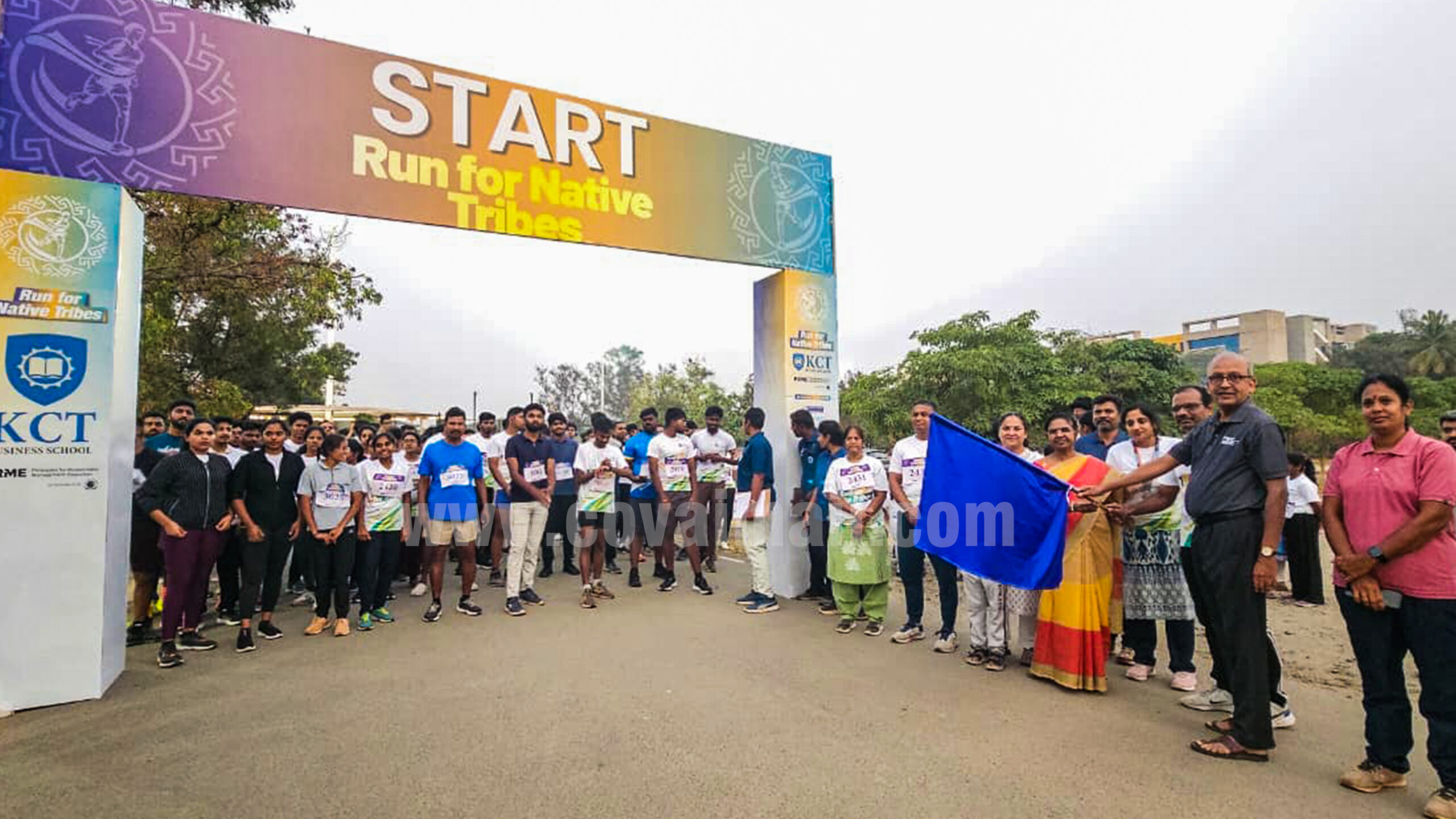


KCT Business School, under Kumaraguru Institutions, organised the third edition of “Run for Native Tribes”, a 5-km marathon-cum-fundraiser, at the Kumaraguru campus in Saravanampatti on January 4, 2026.
The event was organised to support Kallarpudur, a tribal village adopted by the school under its Social Immersion Project (SIP) in 2019. More than 500 participants, including members of the public, students of Kumaraguru Institutions, and children and parents from Kallarpudur, took part in the run.
The marathon was flagged off by Raghupathy, Director – Strategic Planning and Review, Kumaraguru Institutions, in the presence of Ezhilarasi, Principal, Kumaraguru College of Technology, and Sangeetha, Head (i/c), KCT Business School.

About Kallarpudur
Kallarpudur is a tribal hamlet located in the foothills of the Nilgiris. Despite its rich cultural heritage, the community faces challenges related to healthcare access, education, sanitation, livelihood opportunities, and infrastructure. Since 2019, KCT Business School has adopted the village under its Social Immersion Project, focusing on sustained, long-term developmental interventions rather than one-time outreach activities.
About the run
Run for Native Tribes is an annual fundraising marathon organised and executed entirely by MBA students with faculty mentorship. The event serves as a platform that brings together students, faculty, corporates, NGOs, professionals, and the general public to collectively support tribal upliftment.
Funds raised through registrations and sponsorships are utilised for SIP initiatives under faculty supervision, supported by structured reporting mechanisms. The key focus areas include solar energy and infrastructure, menstrual health and hygiene, education and school development, nutrition and public health, sanitation and hygiene, and livelihood and skill development.
Focus areas for 2026
In 2026, the Social Immersion Project aims to extend solar street lighting in Kallarpudur to enhance safety and promote renewable energy usage. Waste management initiatives will be strengthened through waste segregation systems, community dustbins, and regular cleanliness drives.
Youth employability will be enhanced through hands-on training, access to tools, and exposure to job-oriented programmes. Local cottage businesses will be supported through improvements in product quality, packaging, branding, pricing, and digital market access to ensure sustainable livelihoods.
The Sober Childhood initiative will continue, focusing on substance abuse awareness, responsible parenting, and child well-being. Efforts to reduce school dropouts will include parental engagement, academic support, and collaborations with schools and NGOs.
Community workshops on health, hygiene, financial literacy, education, entrepreneurship, and life skills will also be conducted to strengthen participation and informed decision-making. Overall, the project aims to deepen the impact of SIP by ensuring sustainable development, improved quality of life, and meaningful student engagement.