

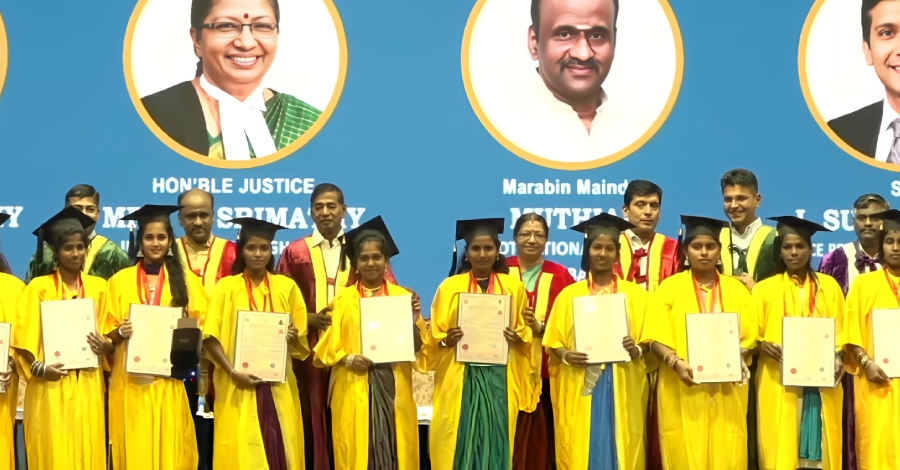
KPR Mill Ltd., one of India’s largest textile and apparel manufacturers, continues to empower its workforce by offering women employees the opportunity to pursue undergraduate and postgraduate programs through Tamil Nadu Open University entirely free of cost.
Over the years, this initiative has transformed the lives of more than 40,000 women who have successfully graduated through the open education system.
During the 12th Graduation Ceremony of the KPR Women Employees Educational Division, held on Sunday at the company’s Thekkalur facility, a new batch of more than 600 graduates was honored.
The event was presided over by K.P. Ramasamy, Chairman of the KPR Group, while Justice S. Srimathy of the Madras High Court’s Madurai Bench attended as the Chief Guest to present degrees and honor the university toppers.
Motivational speaker ‘Marabin Maindan’ Muthiah and J. Sujith Kumar, Vice President of HR at Infosys Ltd., took part as Guests of Honor.
C.R. Anandakrishnan, Executive Director of KPR Mill Ltd., welcomed the gathering, followed by an annual report from P. Saravanapandi, the Principal of the educational division.
The principal highlighted that the company has partnered with Tamil Nadu Open University to offer 7 UG and 7 PG courses, alongside a collaboration with the National Institute of Open Schooling to support employees from Northern India.
Under the leadership of Chairman K.P. Ramasamy, the program currently supports 5,500 women in their studies. This year, 618 candidates received their degrees, surpassing last year’s total of 597.
Academic excellence remained a hallmark of the program, with students bagging 17 university ranks this year, including a clean sweep of the top three ranks in the BBA, B.Com, and B.Com CA programs.
Beyond traditional degrees, the educational arm provides specialized training such as TNPSC coaching and software training via Zoho. The impact of this education is evident in the career transitions of the staff; this year, 40 nursing graduates have already been placed in hospitals, and the mill is actively working to place other degree holders in the IT sector. This follows a successful previous year where 200 candidates were placed in various companies.
Justice S. Srimathy, in her convocation address, appreciated K.P. Ramasamy’s commitment to educating nearly 43,000 women.
She then discussed India’s unique demographic advantage. She noted that with a population of 145 crore, India’s strength lies in its youth, particularly the 20–45 age group. As 18 crore women fall within this demographic, she urged the graduates to consider how they can contribute to India’s development.
By highlighting that several products and equipment important to India are imported, she suggested that if each of India’s 806 districts specialized in a specific product, the nation could significantly reduce imports and generate massive employment. She encouraged the graduates to think about what they could do to achieve this goal.
Muthiah, who offered a felicitation, appealed to the graduates to pursue happiness. He encouraged them to strive toward greater joy in life, as they are now armed with the power of education.
In his address, Sujith Kumar emphasized that education acts as a generational catalyst; when one generation commits to learning, it transforms its own circumstances while lighting the path for the next.
He pointed out that India’s Gross Enrollment Ratio is at 27%, meaning only 27 among 100 people enroll in college in the country. “You all are among that 27%,” he remarked.
He urged the graduates to honor their hard-earned degrees by achieving something phenomenal with it. He challenged them to maintain a ten-year vision and a strategic roadmap for their futures. By mapping out long-term goals, he noted, they can ensure that their individual success contributes to the broader transformation of society that education promises.