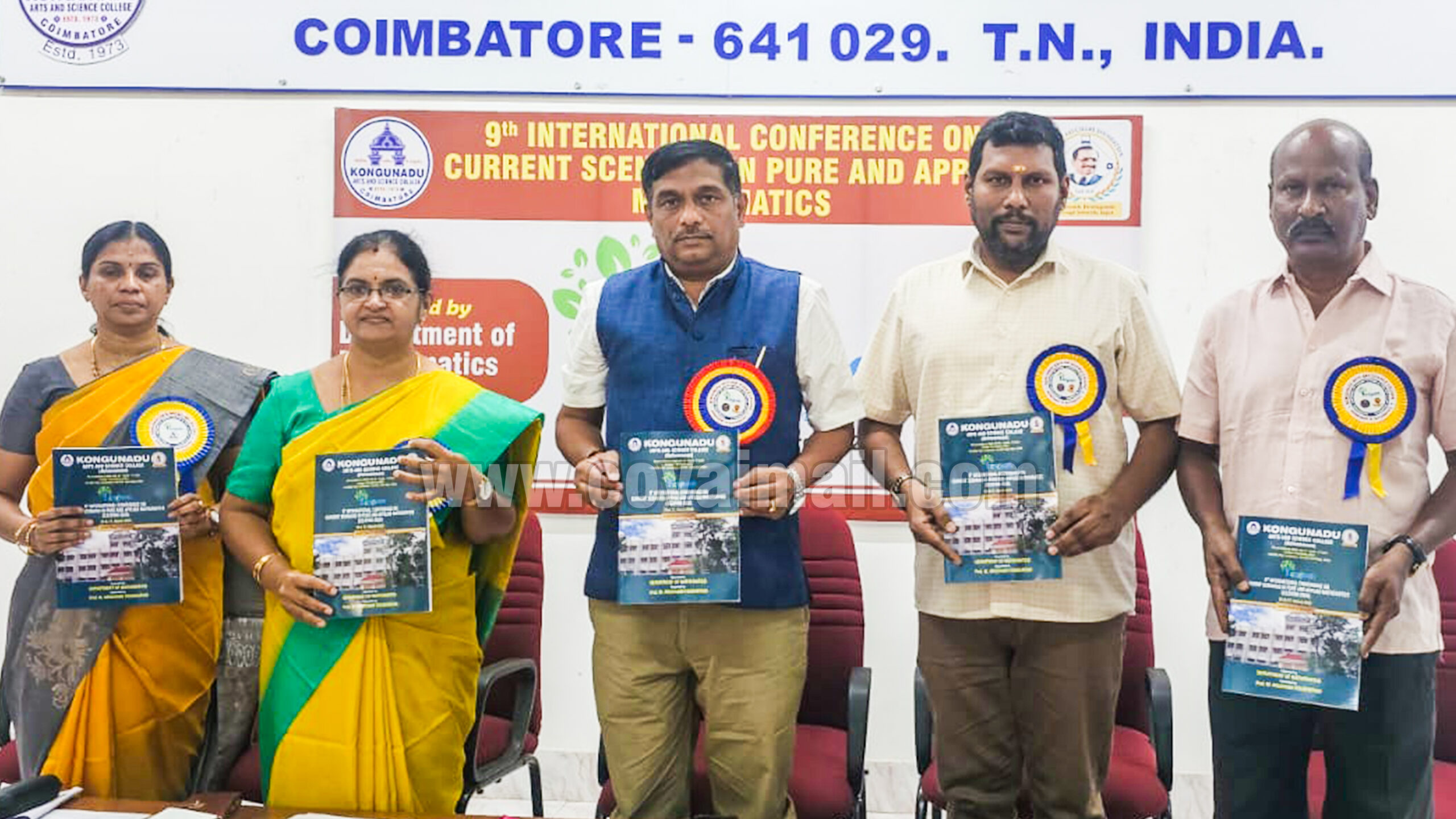
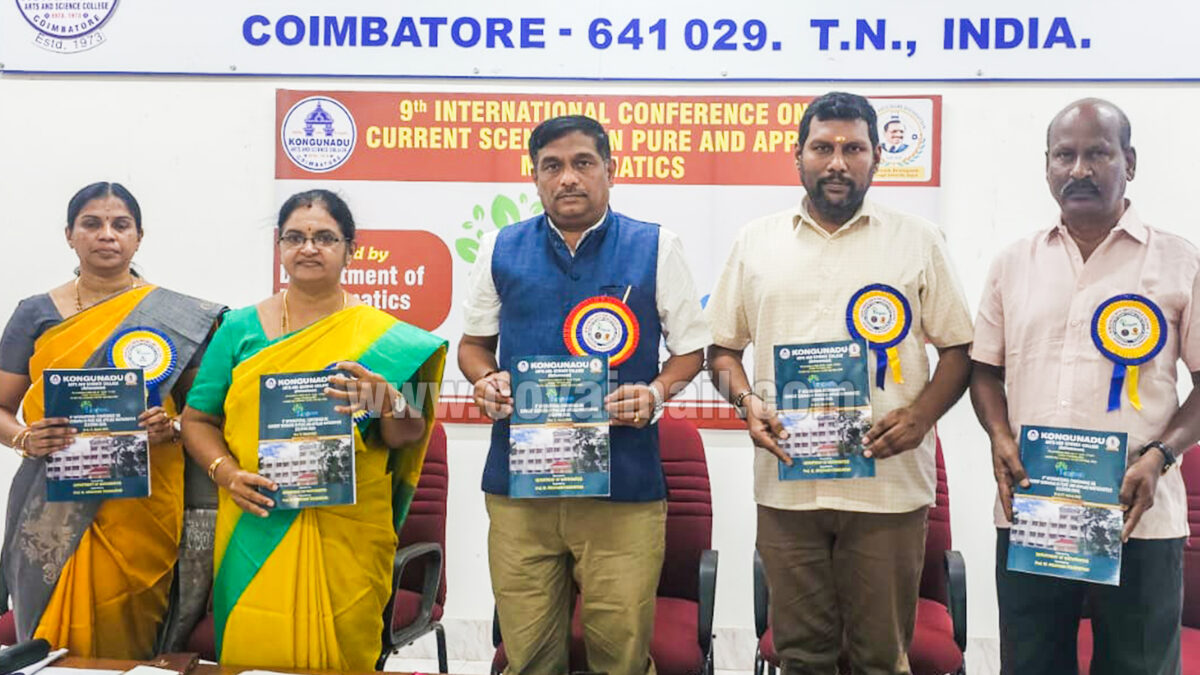
The Department of Mathematics of Kongunadu Arts and Science College recently organized the 9th International Conference on Current Scenario in Pure and Applied Mathematics (ICCSPAM2026) in hybrid mode.
Kokilavani, Head of the Department of Mathematics and Convener of the conference, welcomed the gathering. Sangeetha, Principal of the College, delivered the Presidential Address, in which she emphasized the importance of Mathematics and its applications across various fields.
Paulsamy, Director, Prof. M. Aruchami Research Foundation, offered the felicitation. In his address, he highlighted the role of Mathematics in transforming real-world problems into mathematical models and its significance in arriving at appropriate solutions.
Lokesha, Department of Studies in Mathematics, Vijayanagara Sri Krishnadevaraya University, Karnataka, released the abstract book of the conference and delivered the special address. He congratulated the Department of Mathematics for successfully organizing ICCSPAM for the ninth consecutive time and encouraged participants to make effective use of such academic forums.
Venkatachalam, Assistant Professor of Mathematics and Organising Secretary of the conference, proposed the vote of thanks for the inaugural session.
Following the inaugural session, Suresh Rasappan, Department of Mathematics, University of Technology and Applied Sciences – Ibri, Sultanate of Oman, delivered a lecture on “Quantum Computing for Image Processing with Linear Algebra as the Bridge” in Technical Session I. He explained fundamental concepts of quantum computing, such as qubits, superposition, and entanglement, and demonstrated image processing techniques using MATLAB.
In Technical Session II, Parvathi, Associate Professor of Mathematics, Vellalar College for Women, Erode, delivered a lecture on “Circular Intuitionistic Fuzzy Sets.” She explained the process of converting real-world scenarios into mathematical models, clarified the difference between membership and characteristic functions, and emphasized the importance of intuitionistic fuzzy sets. She also discussed matrix operations and their applications in image processing with relevant examples.
In Technical Session III, Lokesha spoke on “Exploring the Universe Through Topological Indices and Network Geometry.” He discussed topological indices, their congruence, and concepts such as Betti numbers and persistent homology.
In Technical Session IV, Boregowda, Associate Professor, DOSR in Mathematics, Tumkur University, Karnataka, delivered a lecture on “QSPR Models of Some Chemical Structures through Graph Invariants.” He explained how molecules can be represented as graphs and analyzed using topological indices, highlighting their advantages in saving time and promoting innovation.
More than 80 scholars from across the globe presented their research papers in various fields of mathematics.
The best presenters in each session were awarded the Best Paper Award.
On the second day of the conference, Dafik, Professor of Mathematics, University of Jember, Indonesia, delivered a lecture on “A Novel Rainbow Antimagic Coloring Approach for Watermarking in Blockchain-Based Digital Certificates” in Technical Session V. He discussed blockchain technology, watermarking, and the application of rainbow antimagic colouring in securing digital certificates.
In Technical Session VI, Ismail Naci Cangul delivered a lecture on “Some Open Problems in Combinatorial Graph Theory Related to Realizability,” where he discussed key theorems, challenges, and open research problems.
In Technical Session VII, Ayman Badawi presented a lecture on “On the M-Graph of a Finite Abelian Group,” explaining fundamental concepts, theorems, and proofs related to M-graphs.
In Technical Session VIII, Raúl Falcón delivered a lecture on “Two New Cryptographic Protocols Based on Autoparatopisms of Latin Squares.” He explained cryptographic concepts using autoparatopisms, introduced a new encryption technique, and discussed multilevel secret sharing schemes.
In Technical Session IX, Bindusree delivered a lecture on “Research Paths in Mathematics by Integrating Ancient Mathematical Techniques with Modern Methods.” She highlighted research opportunities by combining traditional mathematical approaches with modern tools such as Artificial Intelligence and Machine Learning.
During the valedictory session, Vidyarani welcomed the gathering. Mohanapriya presented the conference report. Narasimhamurthy delivered the valedictory address, emphasizing the importance of such academic gatherings.
Finally, Priyalatha proposed the vote of thanks. Nearly 100 participants attended the two-day conference and benefited from the sessions.